Why Slant Eyes Doesn't Bother Me
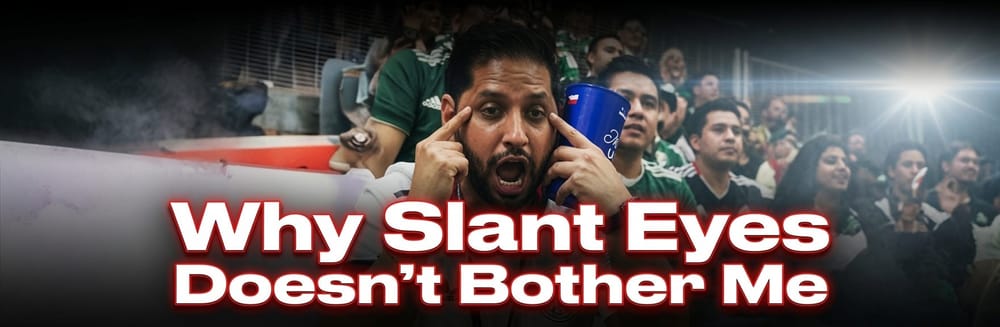
As an Asian person, I suppose I'm expected to be offended by the slant-eyes gesture.
I'm not.
That's not because the gesture isn't racial. Of course it is. The entire point of the gesture is that Asians tend to have different eye shapes than other groups.
The Response I now have is: So what?
There are real examples of racism in the world.
Real hatred. Real discrimination.
Real people being targeted because of their race.
Compared to that, a guy making a slant-eyes gesture at a soccer game barely registers on my list of concerns.
What interests me more is why so many people immediately assume they know exactly why he did it.
If you watch the video, the man doesn't appear angry. He doesn't appear threatening. He doesn't appear hostile. He makes the gesture and then laughs it off immediately. Not even in a demeaning way.
That doesn't automatically make it acceptable.
But intent matters.
People do things that are rude, awkward, immature, or poorly thought out all the time without malicious intent. The modern tendency is to assume the worst possible motivation and then punish accordingly.
The Missing Context
I'll offer another perspective.
Two strangers from different countries meet at a soccer game.
They don't share a language. They don't know each other.
What exactly are they supposed to communicate with?
When I meet people from different backgrounds, I look for common ground. Maybe it's idols. Maybe it's video games. Maybe it's food, travel, music, sports, or some other shared interest.
You search for something both people understand.
In this case, language isn't available.
The only immediately obvious thing connecting them is that they're both at the same event and that they visibly come from different backgrounds.
So communication becomes visual.
A wave.
A thumbs up.
A peace sign.
A team scarf.
Some exaggerated facial expression.
Something to stand out from the crowd.
What I see in this interaction is not someone expressing hatred.
I see someone attempting to communicate the most obvious thing he notices.
"Hey, you're Asian."
That's it.
He's not saying Asians are inferior.
He's not saying he hates Asians.
He's not telling her to go home.
He's not insulting Korea.
He's not mocking her team.
He's not celebrating a victory at her expense.
He's simply acknowledging a visible difference in the most juvenile way imaginable.
You can call it insensitive.
You can call it immature.
You can call it idiotic.
But those are very different accusations from hatred, bigotry, or racism in the way most people understand those words.
The Question Nobody Asks
People today often skip over the most important question:
What was the intent?
If Korea had just lost and he had deliberately singled her out to mock her, that would be a different discussion.
If he had followed her around, shouted slurs, harassed her, or tried to make her feel unwelcome, then there would be a much stronger case that hostility was the goal.
But none of that appears to have happened.
And even if I grant every criticism being made—even if I grant that the gesture was racial, offensive, and inappropriate—I still find myself asking the same question:
Then what?
What actual harm was done?
Was someone denied an opportunity?
Was someone threatened?
Was someone excluded?
Was someone physically harmed?
Or was it simply a brief, awkward interaction between two strangers that lasted a few seconds?
Not every offense deserves the same level of outrage.
Not every act involving race deserves the same level of punishment.
One of the biggest problems with modern discourse is that people increasingly refuse to distinguish between stupidity, awkwardness, insensitivity, and genuine malice.
Those are not the same thing.
A person can be rude without being hateful.
A person can be insensitive without being a bigot.
A person can be an idiot without being a racist.
Sports Rivalries and Intent
As a sports fan, I've always believed the line should be simple: cheer for your team as loudly as you want, but don't go out of your way to attack the other side.
As a former Texas Longhorn, I honestly find people making upside-down Longhorn signs more disrespectful. At least those gestures are explicitly intended to insult the opposing side.
This wasn't even that.
It was a brief, somewhat distasteful interaction between two strangers.
The real issue isn't whether someone is allowed to dislike the gesture.
The real issue is whether every awkward racial interaction must immediately be interpreted as evidence of hatred.
Sometimes people are just being idiots.
And that's okay.
The Yuli Gurriel Example
As a Houston Astros fan and a Japanese weeaboo, I felt similarly about Yuli Gurriel's gesture during the 2017 World Series.
Distasteful? Sure.
Worth criticizing? Probably.
But I never believed it demonstrated some deep hatred of Japanese people.
He had just hit a home run off Yu Darvish. Emotions were high. He made a dumb gesture and a dumb comment.
What often gets forgotten is that Darvish himself took a relatively measured position. He called the gesture disrespectful but emphasized that people can learn from mistakes.
Years later, Darvish approved Gurriel joining the Padres organization, and the two eventually became teammates.
That doesn't mean the gesture was good.
It means the people directly involved were able to view the incident with more nuance than many of the people arguing about it online.
And maybe that's the lesson.
Not every racial incident needs to become a morality play.
Context matters.
Intent matters.
And sometimes a stupid moment is just that.