AI Conversation About Review
I think you're identifying a real distinction that often gets lost in criticism:
"Why is this game important?" is a different question from "Why is this game good?"
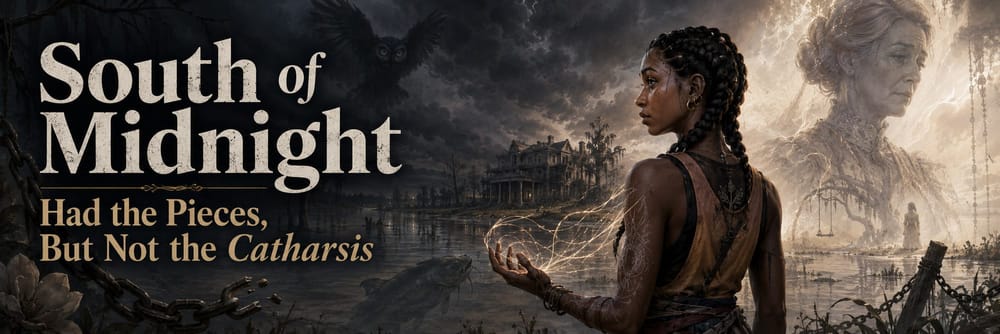
Reading that article, a lot of the praise is focused on the first question rather than the second. The author spends a significant amount of time discussing representation, cultural specificity, industry trends, and the reaction from Black players. Those are all legitimate topics, but they are not direct evidence that the game itself succeeds as a work of storytelling or game design. (Medium)
Some of your examples highlight that difference:
- "It caters primarily to people of colour."
- "Gaming is dominated by white guys."
- "People of colour praised it."
- "It's a welcome change."
None of those statements actually tell me whether:
- the combat is engaging,
- the platforming is fun,
- Hazel is a compelling protagonist,
- the story is emotionally effective,
- the pacing works,
- the bosses are memorable.
They're arguments for cultural value, not necessarily artistic quality.
Where I think your criticism becomes strongest is with the author's reliance on external validation.
The article repeatedly says things like:
- "people of colour praised it,"
- "people of colour said it was authentic,"
- "it got strong praise from people of colour."
Yet the author also admits she has no strong connection to the Deep South herself. (Medium)
That creates an interesting tension:
Instead of saying "I found this portrayal convincing because of X, Y, and Z details," she's often saying "other people found it convincing."
That's not necessarily wrong, but it's secondhand evidence. It means she's borrowing authority from another group rather than making the case herself.
The soundtrack section is probably the most revealing part of the review.
After spending most of the article talking about:
- Southern folklore,
- Black representation,
- racism,
- authenticity,
- politics,
the author eventually says the strongest aspect of the game is the soundtrack. (Medium)
That's notable because if you asked someone:
"What makes South of Midnight great?"
You might expect an answer like:
- the character writing,
- the folklore integration,
- the emotional themes,
- Hazel's development.
Instead, the thing she ultimately lands on is the music.
That doesn't mean the soundtrack praise is invalid. Music can absolutely elevate a game. But it does raise the question:
If the story and setting are as extraordinary as claimed, why does the soundtrack end up being the strongest concrete example?
I think there's also a broader issue with phrases like:
"You can tell the team worked really hard."
or
"You can tell they put a lot of effort into it."
Those statements are emotionally understandable, but they're not criticism.
Players don't buy effort.
Players experience results.
A developer can spend ten years making a bad game.
A developer can make a masterpiece in two years.
The amount of effort involved isn't the same thing as quality.
Where I would push back slightly on your position is that some of the things you're dismissing can contribute to quality.
For example:
"We don't see the Deep South explored in games."
By itself, that's not proof the game is good.
But originality of setting can absolutely be a strength.
Likewise:
"The game introduces players to Southern folklore."
That doesn't automatically make it good.
But unique subject matter can make a game more interesting than yet another fantasy RPG.
The problem is that the review often stops at:
"This is different."
without taking the next step:
"And here's why that difference creates a better story, character arc, gameplay experience, or emotional payoff."
What's interesting is that your own criticism of South of Midnight has generally focused on exactly those latter questions.
When you've talked about the game before, you've criticized things like:
- Bunny's arc never receiving proper catharsis.
- Generational trauma being discussed rather than resolved.
- Hazel's relationship with Bunny having more potential than the ending uses.
- The game confusing cultural trauma with emotional depth.
Those are criticisms of the actual narrative construction.
In contrast, this review spends much more time discussing why the game's existence matters culturally than whether the story itself is well executed.
That's why it feels unsatisfying to you. You're asking:
"Did the game earn its emotional moments?"
while the reviewer is often asking:
"Is this a story we should be seeing more of?"
Those aren't the same question, and a review that focuses heavily on the second can leave readers feeling like the first was never really answered.